

What is a legacy hardrock mine?
The term “legacy” defines the mine as abandoned or inactive, meaning this page does NOT focus on current mines but rather the impacts of mines that are no longer in use.
Hardrock material includes precious metals (i.e. gold, silver, copper), heavy metals (i.e. lead, cadmium, uranium) and other ores. The hardrock description does not include coal, petroleum, salt, or gravel mining, although information relevant to these mines can be found in the Abandoned Mine Lands section of this page.
Collectively, legacy hardrock mining issues focus on the contamination of land and water in surrounding areas and the complexity of cleaning up these abandoned mine sites.
To stay up to date about abandoned and legacy hardrock mining news and join a community of interested parties, sign up for our new Legacy Hardrock Mine listserv!
Abandoned and Legacy Mine Waste
In 2004, mining sites contributed 52 percent of all hazardous waste sites located on, or next to, Tribal Lands. The hardrock materials mined from these sites include, but are not limited to, gold, uranium, copper, and lead. Mining minerals from the earth requires three processes: extraction, beneficiation, and processing. Extraction is the removal of the ore from the earth. Beneficiation follows extraction and involves working the ore into a more useable form. Finally, mineral processing removes the desired mineral from the remaining ore. The extraction and beneficiation processes produce large quantities of waste; however, the mineral processing phase generally produces most of the hazardous waste. Mine wastes are generally stored in heaps or mounds and in tailings ponds. As mines are abandoned or inactive, becoming legacy hardrock mines, this mine waste continues to contaminate lands and water in perpetuity, unless properly cleaned up.
Mining wastes pose a threat to communities in several ways. Leachate from tailings, acid drainage, and oxidization of heavy metals can be transported by surface runoff to streams and lakes or possibly contaminate the aquifer, thus contaminating human drinking water or harming aquatic life. Contaminated soil from heaps is often transported by wind and deposited to surrounding areas including residential property, public parks, surface water, etc.
EPA conducts and supervises investigation and cleanup actions at a variety of mine sites where hazardous substances have been released into the environment or when there is a threat of such releases of these substances. Cleanups may be done by EPA, other federal agencies, states or municipalities, or the company or party responsible for the contamination. Long-term (remedial) and short-term (removal) cleanup actions occur under the Comprehensive Environmental Response, Compensation, and Liability Act (CERCLA).
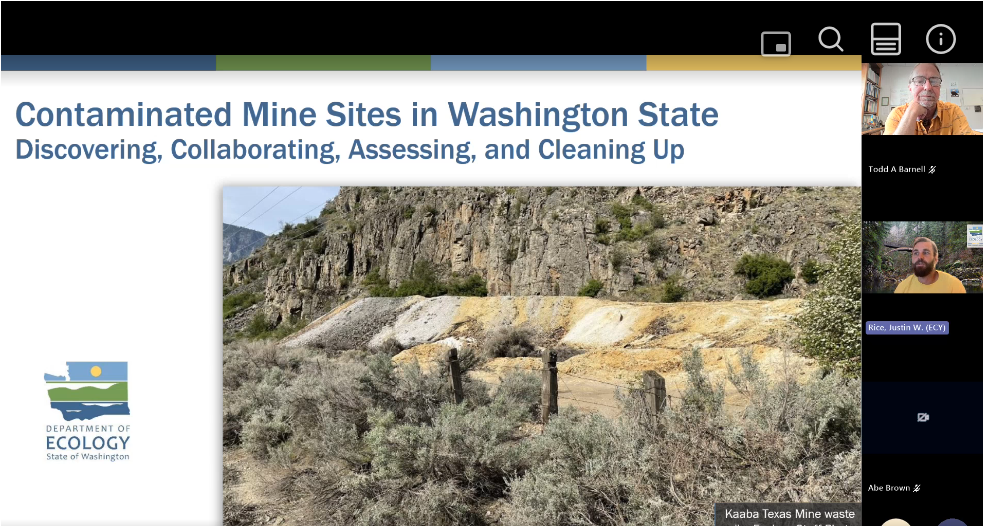
In July 2026 we had our first virtual gathering of the Abandoned Hardrock Mine Network. Justin Rice from the State of Washington’s Department of Ecology and Krista Brown from EPA OMDP presented on their work with abandoned hardrock mines and gave us a starting place to continue to build this network. To be informed of our next virtual gathering, sign up for our AHM listserv above!
Learn more about Abandoned and Legacy Hardrock Mines
Contaminants of Concern at Legacy Hardrock Mines
A long judicial history has made defining hazardous mining wastes quite difficult. Currently, RCRA has named 20 mineral processing wastes that are excluded from federal hazardous waste regulations.
Due to the fact that each mine, depending on processes and desired commodity, may produce a different waste stream, it is difficult to list all chemicals of concern. Essentially, it is the responsibility of the concerned citizen to research the specific wastes from the mine in question.
Here are some examples of typical contaminants for common mines:
Gold – cyanide, cyanide – metals, heavy metals, and acid rock drainage
Zinc/Lead – heavy metals, cyanide, and acid rock drainage
Uranium – uranium and associated radioactivity, radon, arsenic, and lead
Abandoned Mine Lands
What are abandoned mine lands?
The EPA defines abandoned mine lands (AMLs) as “lands, waters and watersheds where extraction, beneficiation or processing of ores and minerals has occurred.” This term, unlike legacy hardrock mining, includes all legacy mines – including mines processing petroleum, coal, sand and gravel, and salt.
Mining wastes pose a threat to Tribal communities in several ways that may not be obvious to other agencies, therefore, it is critical for Tribes to be engaged in the cleanup and redevelopment process. See EPA’s Abandoned Mine Lands: Site Information webpage for information about abandoned hardrock mines and mineral processing sites.
EPA Abandoned Mine Lands Program
The EPA Abandoned Mine Lands (AML) Program is coordinated through the Agency’s National Mining Team (NMT) and Abandoned Mine Lands Team (AMLT). These teams provide an EPA headquarters and regional core of expertise on issues at abandoned mine sites. The teams together serve as a focal point for coordinating and facilitating national technical, policy and process issues with stakeholders on abandoned/inactive mine research, characterization, clean-up and redevelopment activities.
The goal of EPA’s AML Program is to identify ways to protect human health and the environment by using all of the non-regulatory and regulatory approaches available to the Agency. The EPA AML program defines AMLs as: “Those lands, waters, and surrounding watersheds contaminated or scarred by extraction, beneficiation or processing of ores and minerals, including phosphate but not coal*. Abandoned mine lands include areas where mining or processing activity is temporarily inactive.”
*Although acid mine drainage/acid rock drainage caused by coal mining commonly results in significant environmental impacts, Congress has designated the Department of the Interior’s Office of Surface Mining as the Federal authority responsible for addressing these coal mining contamination problem
Obtaining Technical Assistance and Support
The Office of Surface Mining Reclamation and Enforcement (OSMRE) works with Tribes to ensure that citizens and the environment are protected during coal mining and that the land is restored to beneficial use when mining is finished, including reclaiming and restoring lands and water degraded by mining operations before 1977. See OSMRE information for Tribal governments.
Applicable Laws, Regulations, Policies, and Guidance Documents
The Good Samaritan Remediation of Abandoned Hardrock Mines Act of 2024 allows qualified volunteers (“Good Samaritans”) to remediate abandoned hardrock mine sites by easing regulatory barriers and providing protections from previously discouraging environmental liabilities under the Clean Water Act, 1972, and CERCLA, 1980. Because many of the mining companies that created and abandoned the most dangerous legacy hardrock mine sites are dissolved, the Good Samaritan Act aims to promote the cleanup of legacy mine sites where no responsible party exists.
Section §319(h) of the Clean Water Act (1979) offers funding opportunities for nonpoint source pollution via annual base funding and competitive grants. Funding awards can range from $40,000-$70,000 and up to $125,000 respectively. To be eligible, tribes must be federally recognized and obtain Treatment as State (TAS) status by the application deadline.
The Abandoned Hardrock Mine Reclamation (AHMR) Program allocates small amounts of funding for reclamation or remediation projects on Abandoned Mine Lands (AML) due to legacy hardrock mining-caused environmental effects. The AMHR program includes AMLs on Federal, Tribal, State, and private lands. The program is a combination of federal funding for AMLs on lands managed by the Department of the Interior and the US Department of Agriculture/Forest Service, and grant programs for Tribes and States.
US Department of the Interior’s Office of Surface Mining Reclamation and Enforcement’s (OSMRE) website provides information on mining laws, regulations, and guidance. This includes a summary of the Surface Mining Control and Reclamation Act enacted in 1977, and links to OSMRE’s federal register notices, compliance with the endangered species act, select executive orders, and select memorandum of understanding.
EPA’s Abandoned Mine Lands Policy and Guidance webpage contains EPA policy and guidance documents that have direct applications to the assessment and remediation of abandoned mine lands. These policies and guidance documents must be taken in the context of the National Contingency Plan Overview (NCP), which is the overarching planning document governing Superfund actions. All policies and guidance documents are official Agency documents that reflect Agency approaches at the time of their issuance.
Reference Guide to Treatment Technologies for Mining-Influenced Water (94 pp) highlights select mining-influenced water (MIW) treatment technologies used or piloted as part of remediation efforts at mine sites.
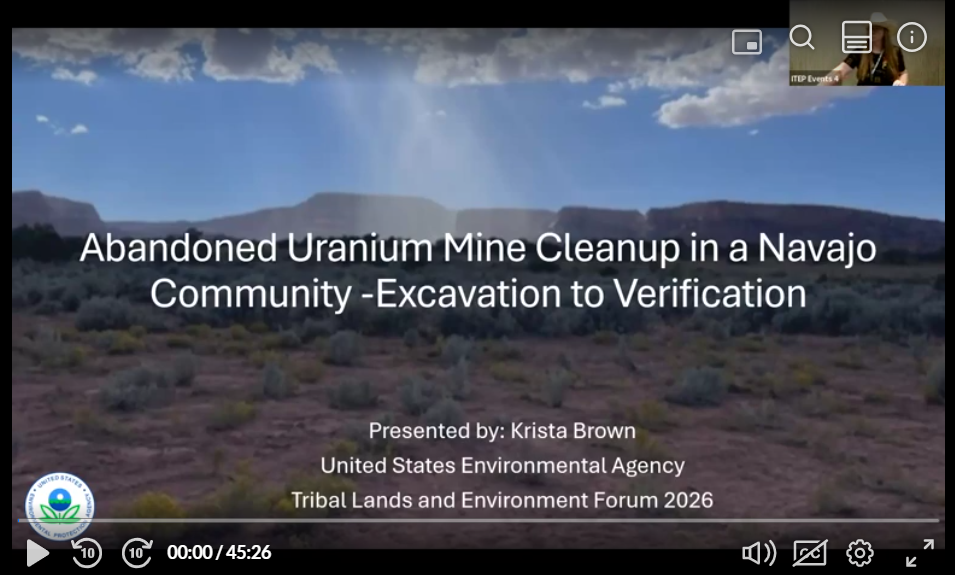
The 2026 Tribal Lands and Environment Forum featured several sessions focused on abandoned hardrock mines and opportunities for remediation. Visit our Mediaspace channel to view these sessions and additional content related to legacy hardrock mines.
For more information please contact:
Todd Barnell, Project Director
928-523-3840
Todd.Barnell@nau.edu